
Most people are not really living their life. They are drifting through it.
They never sat down and decided where they wanted to end up, so they let the days carry them. They take the job because it was in front of them. They fill the week with whatever shows up. The years go by, and one morning they look around and realize they landed somewhere they never actually chose.
It is really hard to end up at Disney World by accident. You do not drift into a place worth arriving at. You get there because you decided it was the destination and you pointed the whole trip toward it. A life is no different. Living intentionally is making everyday decisions that move you toward a future destination. But you cannot intentionally end up somewhere accidentally. Yogi Berra said it best. If you do not know where you are going, you might wind up someplace else.
You cannot intentionally end up somewhere accidentally.
That is where most people are stuck. They are driving their whole life with no destination set. No GPS.
I made up my mind a long time ago that I was not going to live that way. For well over 20 years, I have been writing my own obituary. It is something I review at least once a year, and something I read at least once a week, usually when I sit down to fill in my memento mori calendar.
That obituary is my GPS. It is where I set the destination. Reading it tells me what actually matters before the week gets loud. It quiets the urge to keep score against the guy next to me. It keeps pulling me back toward the life God called me to live, instead of the one I would drift into if I stopped paying attention.
That obituary is my GPS. It is where I set the destination.
Where I learned it
I did not come up with this on my own. Stephen Covey was practically one of my godparents. My dad played his books in the car so much I genuinely cannot tell you what my first audiobook was. One of Covey's seven habits in "The 7 Habits of Highly Effective People" is to begin with the end in mind. He does not mean the end of your quarter. He means the end of your life. He walks you all the way to your own funeral and makes you look.
Take a moment and picture yourself at your own funeral. You can see yourself laying in that casket. The room smells like flowers, because flowers are how we cover the stink of death, and your family is going to smell those flowers in their heads for weeks. They are sitting there. They are weeping over you.
Somebody stands up to give the eulogy. Who is it? And what are they saying?
Are they reading off your net worth? Listing the success you had in business? Talking about the deadlines you beat and the hours you put in? Or are they talking about who you actually were to the people in that room?
Most people have read that chapter and never once did the exercise. They underlined it. They highlighted it. They never actually pictured it. Because it is a whole lot easier to drift through life than to stop and stare at the end of it.
It is a whole lot easier to drift through life than to stop and stare at the end of it.
That funeral is where my obituary started. I figured if Covey was going to make me imagine the eulogy, I might as well sit down and write the thing myself.
What I got wrong the first time
The first obituary I ever wrote was horrible.
Not the writing. Me. I read it back and I was completely out of focus. Every line on the page was a scoreboard. Goals. Money. The stuff I wanted to have, not the person I wanted to be.
For years the thing driving me was success. I wanted success. Then a few years ago it caught up with me that success was the wrong thing to be chasing in the first place. And once you see the difference between success and excellence, you cannot unsee it.
Success is measuring yourself against other people, against the world. Excellence is measuring yourself inwardly, against the person God has called you to be.
Think about what that means. Success is external. My buddy gets a new truck, and all of a sudden I want a new truck. We all do it. That is success. It is letting somebody else's scoreboard tell you how you are doing, and you can never win it, because there is always a bigger truck. Excellence asks one question instead. Who did God design me to be, and am I becoming that person? That is inward, and it is entirely up to me.
This is why it matters which one you chase. You cannot guarantee success, because the scoreboard is never fully in your hands. Lindsey Vonn cannot guarantee a gold medal, and she cannot guarantee her body holds up. But she can guarantee she shows up and goes ninety miles an hour down that mountain, because excellence is a decision, and you can always be excellent. You can choose it every single day.
Excellence is a decision, and you can always be excellent.
And the strange part is that when you chase excellence, success tends to follow it home. Chase the scoreboard instead, and you never get either one. So when you write your obituary, do not fill it with success. Fill it with the excellence you were made for. That is the part worth being remembered for, and that is the part you start steering your everyday decisions toward.
Measure the gain, not the gap
There is one more trap waiting, even after you have set the destination, and Dan Sullivan put a name on it. He calls it the gap and the gain.
When you measure by success, you stare at the gap, the distance between where you are and where you still want to be. It never closes, so you always feel behind, no matter how far you have come. When you measure by excellence, you measure the gain, the progress from where you started. Same life, two completely different scoreboards. One keeps you anxious and chasing. The other lets you see how far God has already carried you. Your obituary is where you decide which one you are going to live by.
One keeps you anxious and chasing. The other lets you see how far God has already carried you.
Facing it is what sets you free
Sitting down with your own death does one more thing, and it is the part nobody expects. Once you face it on paper, you stop being afraid of it.
Once you face it on paper, you stop being afraid of it.
So much of life turns out to be backwards from what we assume. To gain your life, you have to lose it. That is the strange math at the center of the gospel. Once you have stood at your own funeral and really looked, you can walk away from it and start actually living. The fear loosens its grip. And once you are not afraid of the end, you are free to chase excellence all the way to it, and the success, like I said, tends to come along behind.
That is why I do not write it once and file it away. I read it every week and I write a fresh one every year, because the man I am becoming has to keep answering to the man I said I wanted to be.
If you lead something, write its obituary too
Everything so far is about your one life. If you also run a company, there is a second one worth writing.
I got this from Jesse Cole, the founder of the Savannah Bananas. He writes an obituary for his organization. Not a mission statement for the wall. An obituary. What did this company do? What did it stand for? What did people lose the day it closed its doors?
It works the same way the personal one does. The why you have been chasing gets a lot clearer when you start at the end of the thing instead of the middle of it. The mission stops being a poster nobody reads and turns into a destination you can actually steer the company toward.
The mission stops being a poster nobody reads and turns into a destination you can steer the company toward.
The hard part is not writing it
Writing the obituary is hard. Handing it to somebody is harder.
When you finish yours, and it might take you a couple of weeks, give it to one person you trust. Not to be nice to you. To be honest with you. Ask them straight. Is this a life of excellence? Is this the life you see God has called me to? A goal you write down and say out loud is far more likely to actually happen. The page makes it real. The other person makes it stick.
Because having a destination is not enough. You have to know it is the right one. I know a man who was driving hard toward a future he was sure he wanted, until he became convinced it was the wrong destination. If he did not change tracks right then, he was going to end up somewhere he was never meant to be. He only knew it because he had already gone to the end and looked. You cannot ask whether you are headed the right way until you have named where you are headed.
You cannot ask whether you are headed the right way until you have named where you are headed.
Go write the first draft
So here is what I am asking. Do not wait until the end of your life to find out what it added up to. Go to the end now, on paper, while you can still do something about it.
Do not wait until the end of your life to find out what it added up to.
Write your obituary. It will be bad the first time. Mine was. That is fine. A journey of a thousand steps starts with one step, and this is the step. If you cannot finish it in one sitting, put it on your calendar and come back to it. Then hand it to somebody and ask them the hard question. And next year, write it again, and pay attention to what has changed.
Most people spend their whole lives afraid of this. Fear of death sits right up there with public speaking and heights. But once you face it, you stop drifting. You stop chasing the scoreboard. You start chasing excellence, and you start making your everyday decisions on purpose, toward the one place you actually decided to go. You stop driving with no destination. You finally have a GPS, and it is pointed at the life God built you for. Well done, good and faithful servant.
That is what living intentionally takes. Go write your way there.
I am not just telling you to do it
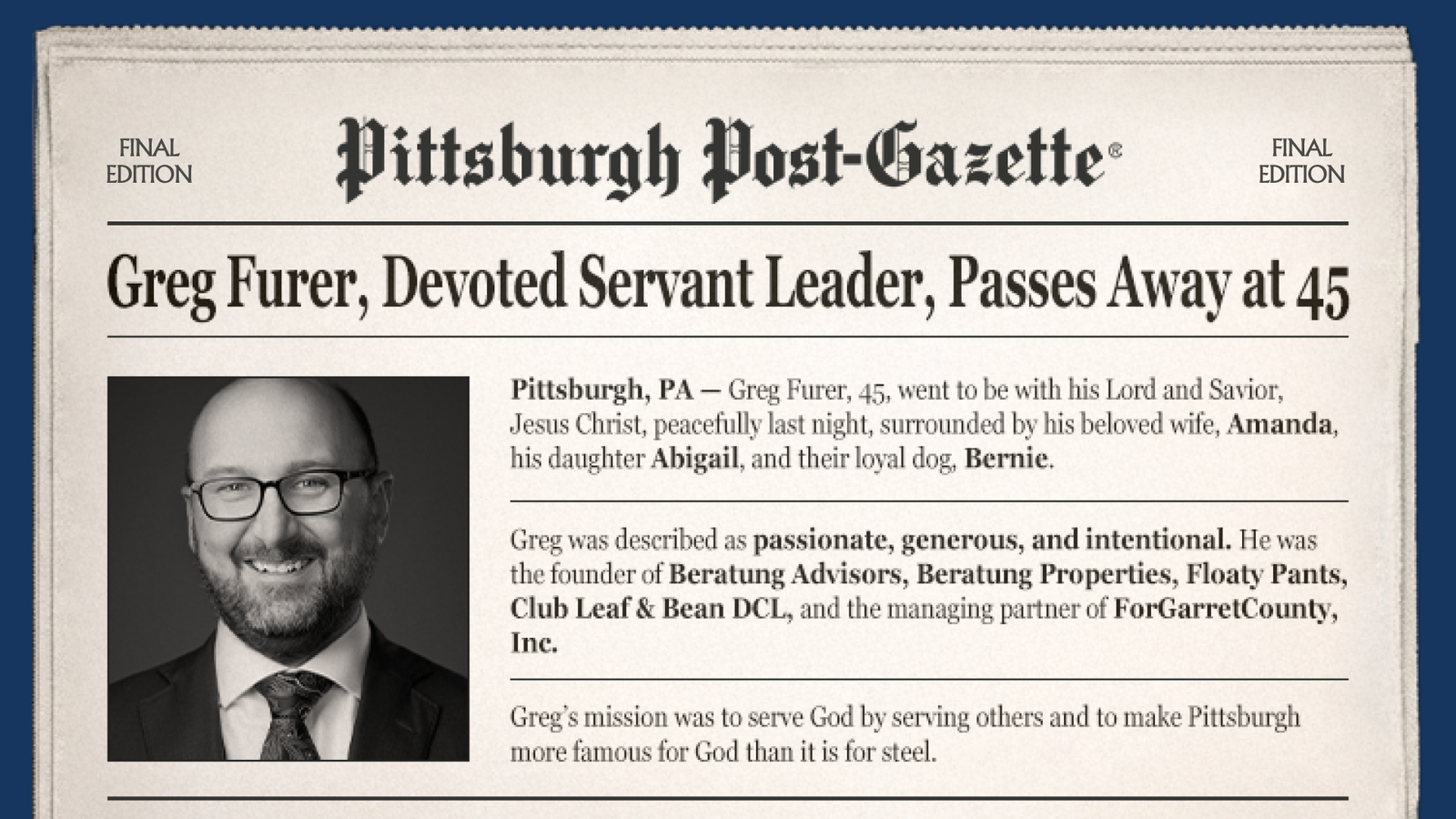
I would not hand you an exercise I have not done myself. I have written a new obituary every year for over 20 years. Here is the one I wrote for 2026, the one I am reading through right now.
Greg Furer went to be with his Lord and Savior, Jesus Christ, peacefully last night, surrounded by his beloved wife, Amanda, his daughter, Abigail, and their loyal dog, Bernie.
Greg was often described with words like passionate, authentic, generous, and intentional, descriptions that captured both his heart and his calling. Above all else, Greg was devoted to serving God. His "why" in life was simple and unwavering: to serve God by serving others.
Greg often said he was building a family, a community, and a company, all designed to serve the Kingdom of God while fully enjoying God's many gifts. He viewed himself as a passionate servant leader, committed to living out his faith with authenticity, joy, and purpose.
Greg was the founder of Beratung Advisors, Beratung Properties, Beratung Tax, AlwaysBeBranding, TeachPassion Leadership, the owner of Floaty Pants and Club Leaf and Bean DCL, and the managing partner of ForGarretCounty, Inc., the owner and operator of Wisp Resort.
Through these ventures, he sought not success for its own sake, but impact. Impact that would outlive him. He was deeply passionate about mentoring and developing others, believing more is caught than taught.
Greg and Amanda were known for opening their lake house at Deep Creek Lake to young couples and emerging leaders, creating space for mentorship, growth, and meaningful conversation.
Greg spent countless hours at the Beratung Retreat Center, guiding, teaching, and investing in people.
A teacher at heart, he also served as a professor at Duquesne University and instructor with Kaplan, and was deeply committed to elevating the financial planning profession.
Greg believed financial advice was rooted in biblical wisdom and that money was simply a tool entrusted to us by God. He held firmly that true stewardship was about ownership, responsibility, and purpose.
Greg was deeply committed to his profession, serving as a board member of the Financial Planning Association and the CFP Board. He often referred to financial planning as the fourth great profession and a noble profession. He made it a lifelong mission that you must be a CFP® professional to call yourself a financial planner.
Greg's life was filled with passion beyond his faith, family, and work. He was an avid skier and boater, happiest when spending time with his family at Deep Creek Lake. He enjoyed bourbon, a great cigar, a three hour dinner with good wine, and time at Club Leaf & Bean. Most importantly, Greg loved doing life together with fellow leaders and friends.
He was known for his "Gregisms," including "Repetition Leads to Retention" and "More is caught than taught." He was the author of several books, including Financial Planning for Yinz, Authentic Leadership, Ugly Couches, Lighthouses, Pickles, and Jelly Beans; How to Use Stained Glass to Share Your Vision and Create Unique Culture; Teach Your Children to Fish: Teaching Your Children How to Lead; and The TeachPassion Leadership Bible.
Greg also served as a Lutheran lay minister, leading a weekly weekday worship service specifically designed for leaders, creating sacred space for faith, reflection, and encouragement in the midst of busy lives.
In Greg's passing, his holdings in Beratung Partners Incorporated have been transitioned into a 501(c)(3) organization, GreaterThanSteel, to continue the vision God placed in his heart and Sam Shoemaker's, to make Pittsburgh more famous for God than it is for steel. This work includes furthering Kingdom work throughout Pittsburgh, including continued support of the Heritage Center, a museum housed in a Beratung Properties building dedicated to telling the story of Christianity in Pittsburgh, curated and operated by the Pittsburgh Leadership Foundation.
This foundation will direct the profits of its enterprises toward furthering Kingdom work in Pittsburgh and glorifying God in all that it does.
In lieu of flowers, donations may be made in Greg's honor to the Pittsburgh Leadership Foundation, as they continue the work of shaping leaders and transforming the city for God's glory.
Greg Furer lived with purpose, led with faith, loved deeply, and leaves behind a legacy that will continue to shape lives for generations in Pittsburgh, Garrett County, and his family.
And because I lead a company, here is Beratung's. The same exercise, pointed at the firm instead of the man.
Beratung Advisors closed its doors after more than a decade of serving families in Western Pennsylvania and beyond.
Founded in 2013, Beratung Advisors was once known as an innovator in the financial planning profession. At a time when most firms defined advice by investment management and asset-based fees, Beratung believed something different. Every client deserved a financial plan, regardless of net worth. Long before it became common practice, the firm charged directly for planning, centered conversations on life goals, and treated financial planning as a calling rather than a product.
In its early years, Beratung Advisors helped redefine what it meant to be a financial planner. It embraced a holistic view of life, one that recognized money as a tool to support faith, family, purpose, and calling. Clients weren't seen as accounts to manage, but as people to be known, loved, and challenged to pursue a fulfilling life.
But like many once-great companies before it, names such as Blockbuster and Kodak, Beratung Advisors eventually lost its innovative edge.
As the world moved toward deeper life planning, coaching, and subscription-based relationships focused on the whole person, Beratung became too focused on refining what it already had instead of asking whether it was still solving the right problem. The firm improved its product but forgot its mission. Somewhere along the way, the question shifted from "Who are we for?" to "How do we make what we do better?"
And that shift proved costly.
Beratung Advisors was originally built on the belief that it existed in the goal business. Technology would change. Markets would rise and fall. Industries would evolve. But humans would always have aspirations, to become who God designed them to be, to steward what they've been given, and to live lives of meaning. As long as people had goals, the firm believed it would always have a role.
Yet over time, that belief faded from the center.
Once deeply committed to generational planning, equipping parents to pass down values, not just wealth, the firm gradually drifted from teaching families how to build legacies rooted in faith and character. It forgot that true legacy is not what you leave to people, but what you leave in them.
Beratung Advisors had once been known for its impact beyond business. Millions of dollars were given to kingdom-focused organizations, including the Pittsburgh Leadership Foundation, Urban Impact, Light of Life, Foundation for Children, Bethlehem Lutheran Church, Bethesda, and others, all in an effort to make Pittsburgh more famous for God than steel. But in its final years, charitable giving declined sharply, and its outward focus narrowed.
At its peak, the firm's influence reached far beyond its client base. But by the end, it served only a fraction of the households it once impacted.
In a final statement, the board of directors of the nonprofit that owned Beratung Advisors reflected:
We had a good run. We did meaningful kingdom work. But there is a season for everything, and this season has come to an end.
Upon liquidation, the firm's physical assets, including a retreat center and multiple properties, were distributed to local nonprofits. The main office was preserved as a heritage center and transferred to a Pittsburgh-based foundation to continue serving the community. The client relationships were transitioned to a national life-planning firm aligned with the profession Beratung once helped pioneer. Some team members were retained. Others were laid off during consolidation. Leadership moved on.
Beratung Advisors is remembered not just for what it built, but for what it forgot.
Its story now stands as a reminder to future leaders. If you ever forget who you are for, you will eventually forget why you exist.
Yours will not read like mine, and it should not. But now you have seen one. Set your destination, and go live toward it on purpose.
Live Intentional.
Securities and advisory services offered through LPL Financial, a registered investment advisor. Member FINRA/SIPC. Securities offered through LPL Financial. Member FINRA/SIPC.